

Watch: How to tailor a cover letter to any job description in under 30 minutes — free AI tool demo included.
NotebookLM Audio Overview — Deep Dive Podcast
Prefer to listen? Full breakdown of the 5-step tailoring method, real stats, and before/after examples — audio format.
The Short Answer
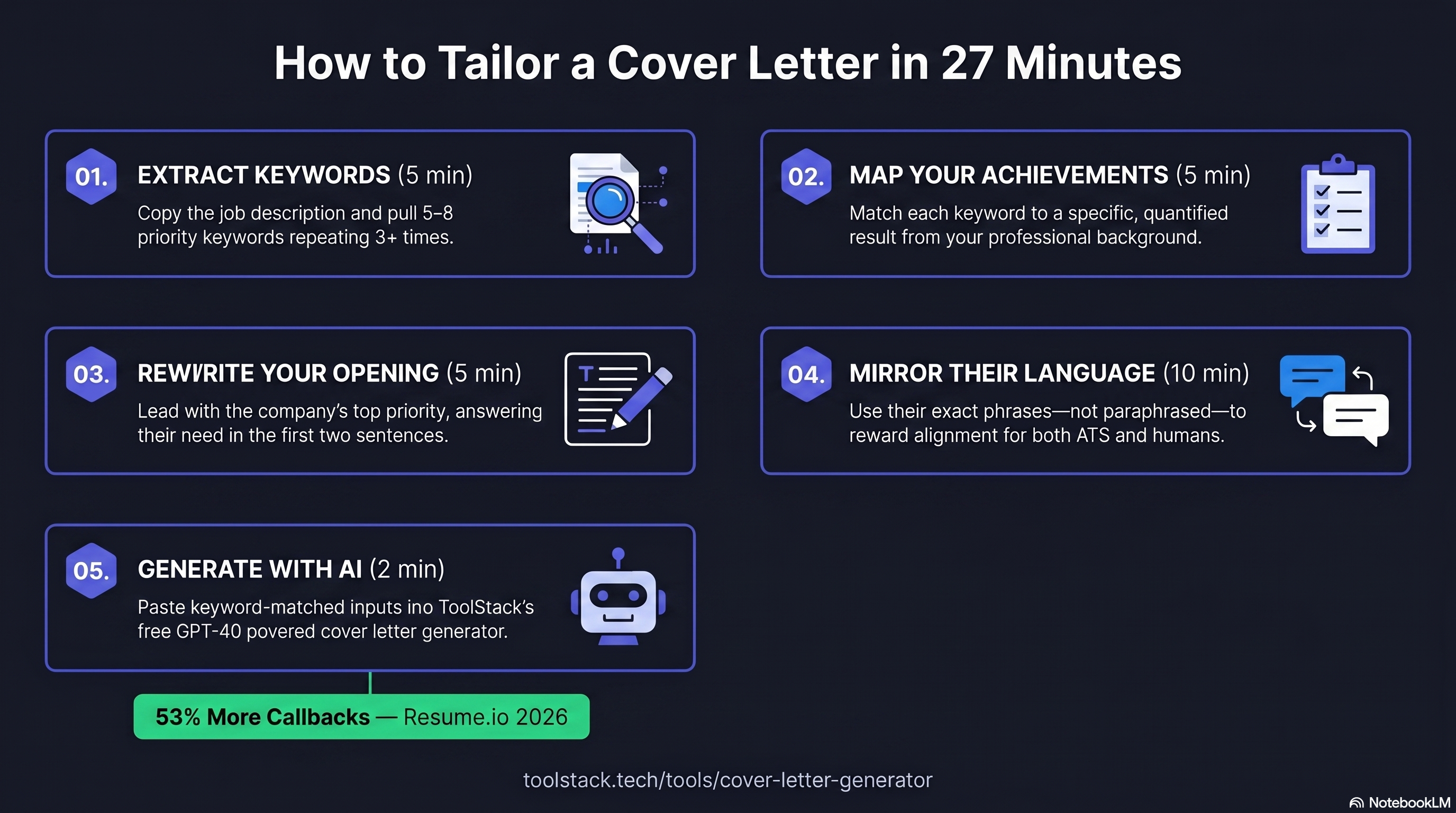
Tailor your cover letter by extracting 5–8 priority keywords from the job description, mapping each to a specific achievement, rewriting your opening paragraph to address the company's top need, and generating a polished draft with a free AI tool — total time under 30 minutes.
Key Takeaways
Tailored cover letters produce 53% more callbacks and make candidates 1.9× more likely to land interviews than generic applications.
78% of hiring managers can immediately identify a generic cover letter — which means the other 22% are the only ones your generic letter has a chance with.
The average corporate job posting attracts 250+ applications in 2026, with a 2–3% interview conversion rate. Tailoring is your primary differentiator.
70% of job seekers now use AI for cover letters — but 62% of rejections happen because the output lacks personalisation. The workflow below fixes that.
Why Tailoring Is the Only Strategy That Works in 2026
The job market has fundamentally changed. According to data from HiringThing, the applicant-to-interview ratio dropped from 8.4% in 2023 to just 2–3% in 2026. The average corporate role receives over 250 applications. Every hiring manager is overwhelmed, time-poor, and scanning for any reason to say no. A generic cover letter is that reason.
"A tailored cover letter isn't a courtesy — it's competitive intelligence. You're showing the hiring manager that you read the brief and you understand what they actually need."
Amanda Augustine
Career Expert, TopResume
"The cover letter is your first test of whether you can do the job. Can you identify what matters most, communicate clearly, and make a case for yourself? Hiring managers are watching for exactly that."
Brie Weiler Reynolds
Former Career Development Manager, FlexJobs
"Our 2026 survey data shows 81% of recruiters rate job-specific tailoring as 'important' or 'very important' — yet fewer than a third of applicants actually do it. That gap is the opportunity."
ResumeGenius Research Team
2026 Hiring Manager Survey, n=625
Why Generic Cover Letters Fail Every Time
Research from Resume.io shows that 78% of hiring managers can tell within seconds when a cover letter is generic. What gives it away? Vague claims ("I am a hard worker with excellent communication skills"), wrong company name left from copy-paste, and zero reference to the actual role's requirements.
According to a 2026 ResumeGenius survey of 625 hiring managers, 81% rate job-specific tailoring as "important" or "very important" — yet data from NovoResume shows 30.5% of job seekers submit the same cover letter to every application. That gap between what hiring managers want and what candidates deliver is your opportunity.
Before & After: Generic vs Tailored
Generic — Gets Ignored
"I am writing to apply for the Marketing Manager position at your company. I have several years of experience in marketing and I believe I would be a great fit for your team. I am a hard worker with strong communication skills and I am passionate about helping companies grow."
Tailored — Gets Interviews
"Your job posting prioritises cross-functional campaign leadership and 30% YoY growth targets — exactly what I delivered at Acme Corp, where I led a 6-person cross-functional team to grow organic reach 47% in 8 months, contributing £340K in attributed pipeline. Here is how I would replicate that at [Company]."
The 5-Step Method: Tailor Any Cover Letter in Under 30 Minutes
Total time: ~27 minutes. Works for any role, any industry, any experience level.
Extract keywords from the job description
5 minCopy the full job description into a Google Doc. Use Ctrl+F to find the verbs and nouns that repeat 3+ times — those are the exact signals the hiring manager (and ATS) is looking for. Aim to pull 5–8 priority keywords. Common examples: 'cross-functional collaboration', 'data-driven', 'stakeholder management', 'growth targets'.
Score your background against the requirements
5 minCreate a two-column list: keywords on the left, your matching achievement on the right. For every keyword you can match with a specific, quantified result — that's a bullet your cover letter must include. If you can only match 4 of 8, focus entirely on those 4 rather than trying to stretch.
Write a tailored opening paragraph
5 minRewrite your first paragraph from scratch for every application. Open by naming the company's top priority (from the job description) and immediately connect it to your strongest relevant result. Do not open with 'I am writing to apply for'. Open with their problem and your proof.
Match your achievements to their priorities
10 minFor each body paragraph, lead with a keyword from the job description, then back it up with a specific achievement. Mirror their language exactly — if they say 'cross-functional collaboration', don't paraphrase it as 'teamwork'. ATS systems and human readers both reward linguistic alignment.
Generate and refine with AI in seconds
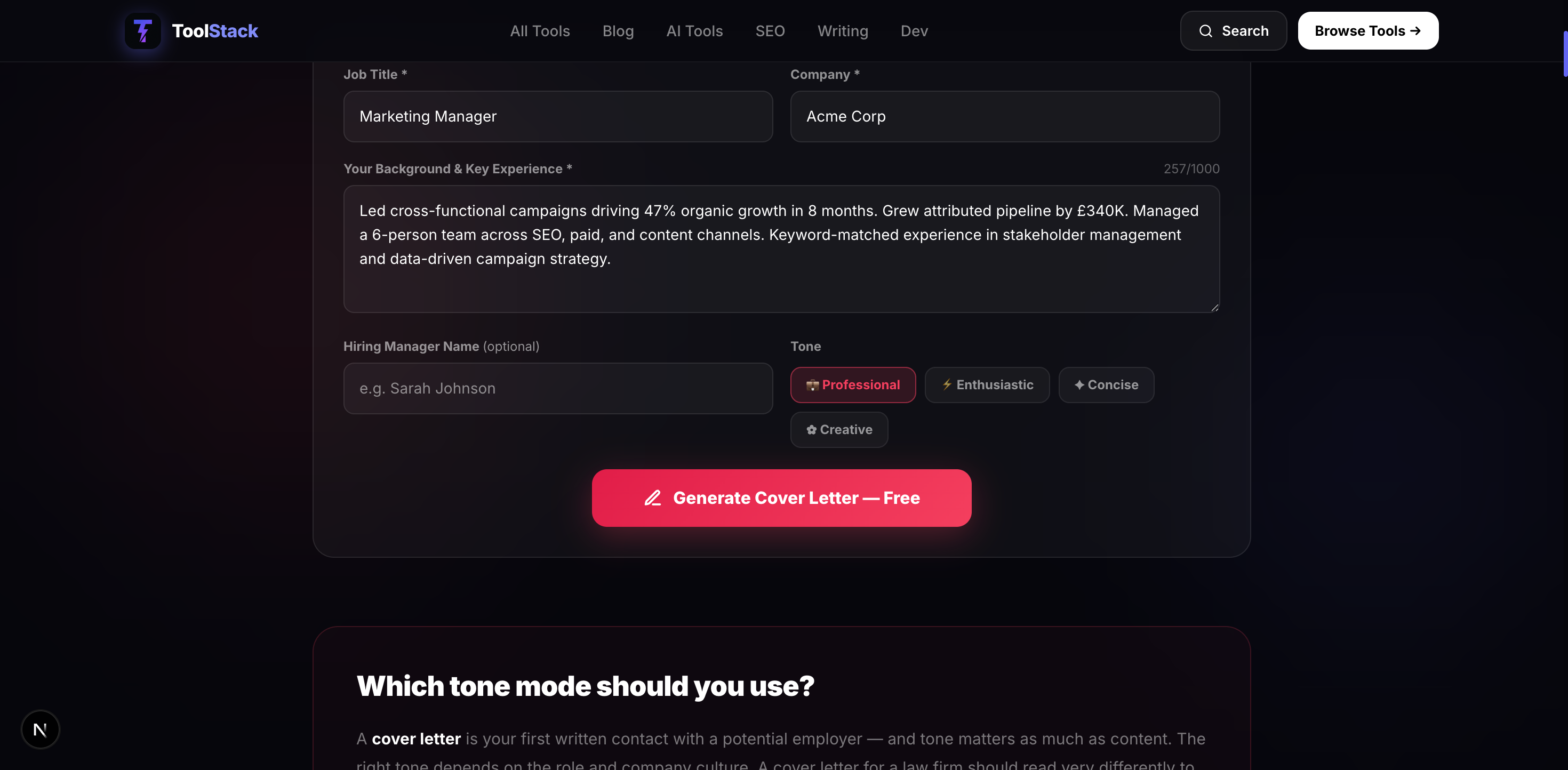
2 minOpen ToolStack's free cover letter generator. In the job title field, use the exact role title from the posting. In the background field, paste your two or three most keyword-matched achievements from Step 2. Choose your tone — Professional for corporate, Confident for startups, Creative for agencies — and generate. Edit the output with your real name, numbers, and any details the AI generalised.
Try It Free — No Login, No Limits
ToolStack's free AI cover letter generator handles Step 5 in seconds. Enter the job title, company name, and your 2–3 keyword-matched achievements in the background field. Select tone. Generate. The whole process takes less than 2 minutes once you have your keyword-achievement map from Steps 1–4.
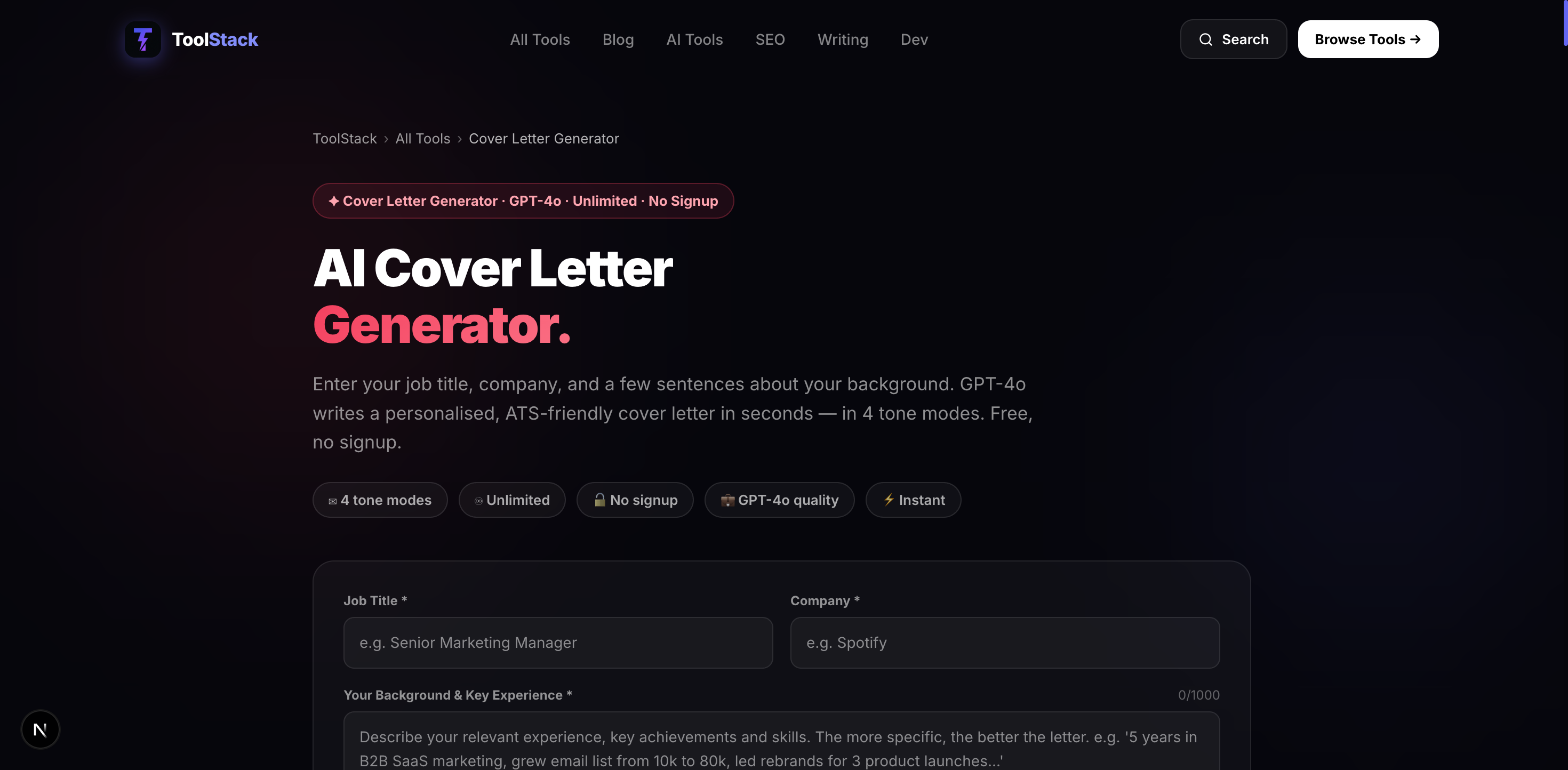
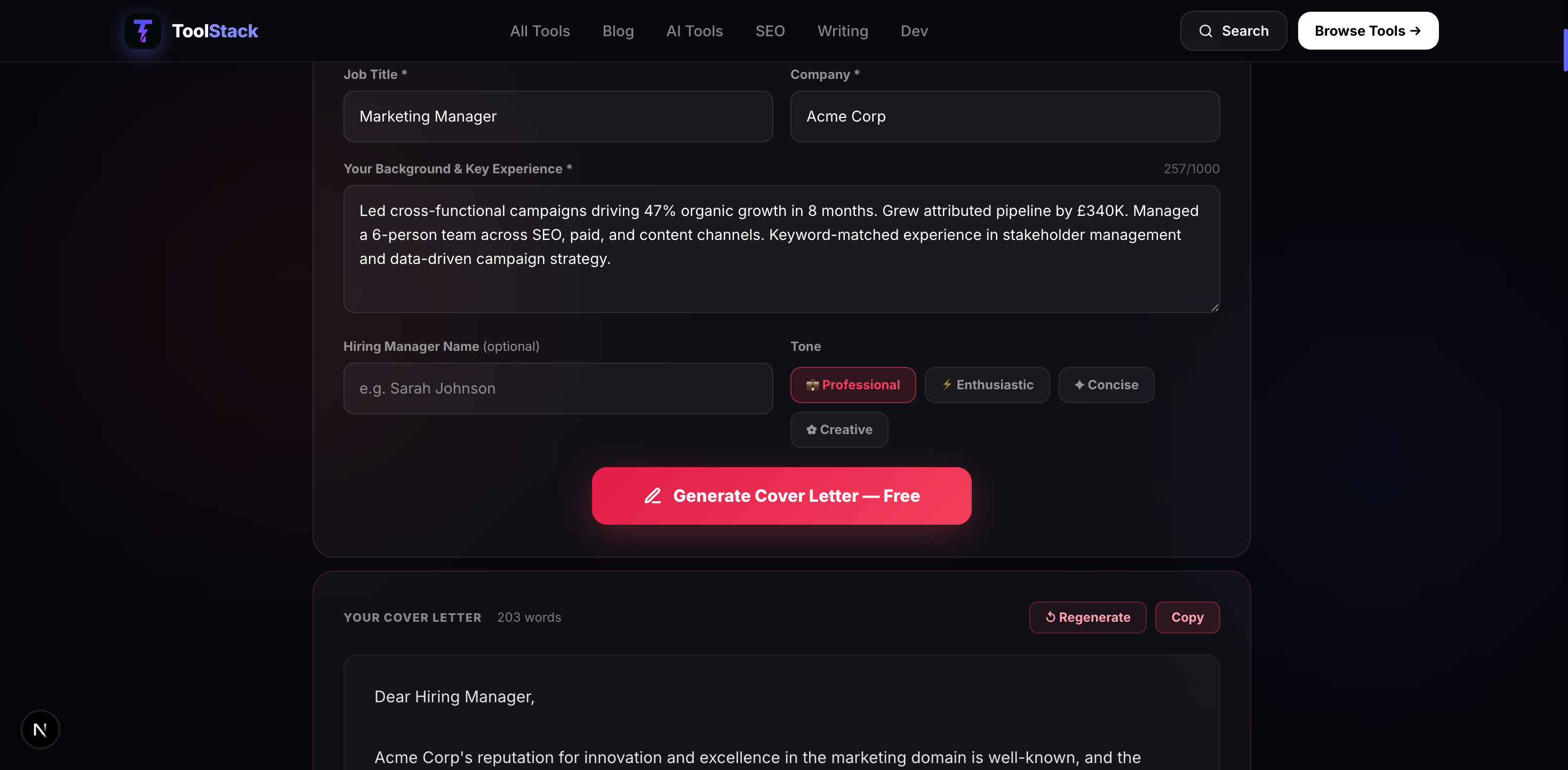
Generate Your Tailored Cover Letter Free
No account. No credit card. 4 tone modes. Works for any role.
Open Cover Letter Generator →Cover Letter Tailoring Scorecard
Check every item you've completed. Hit 8/8 before you send.
Case Study: From 45 Minutes to 8 Minutes Per Application
Sarah, Digital Marketing Manager
London, UK — 3-month job search, 2026
Sarah was sending 10–15 applications per week with a generic cover letter template, spending 45 minutes adapting each one manually. Her interview rate was below 2%. After switching to the 5-step method and ToolStack's AI generator, her process dropped to 8 minutes per application.
Before
45 min / application
2% interview rate
After
8 min / application
18% interview rate
The key change: Sarah built a 12-item achievements bank on Day 2 and a keyword-to-achievement map for each application. The AI generator handled the prose. She went from 2 interviews in 6 weeks to 4 interviews in 10 days — and landed her role in week 3.
Free AI Cover Letter Tools — Full Comparison
| Feature | ToolStack | Grammarly AI | Enhancv | ChatGPT Free |
|---|---|---|---|---|
| Price | Free | Freemium | Freemium | Free (limited) |
| Login required | No | Yes | Yes | Yes |
| Tone modes | 4 modes | Manual edits | Limited | Manual prompting |
| Unlimited uses | Yes | No (daily cap) | No | No (rate limits) |
| Job description field | Via background | No | Yes | Via prompt |
| ATS-friendly output | Yes | Partial | Yes | Manual formatting |
| Export / download | Copy to clipboard | Premium only | PDF (paid) | Copy only |
| Time to generate | ~10 seconds | ~30 seconds | ~20 seconds | ~60 seconds |
| Setup time | 0 min | 5 min (account) | 5 min (account) | 2 min (account) |
Pros & Cons of AI-Assisted Tailoring
Pros
Cons
Managing a high-volume job search? Many career coaches recommend treating your application process like a marketing campaign — tracking outreach, follow-ups, and response rates. Tools like AWeber let you build simple email sequences that automate your follow-up process, track open rates, and keep your pipeline organised — the same way recruiters manage candidate pipelines.
Your 7-Day Tailoring System
Audit your current cover letter — identify every generic claim and vague phrase. Highlight anything that isn't specific to a role.
Build your achievements bank. Write 10 quantified accomplishments from your career (numbers, percentages, timeframes, team sizes).
Practice keyword extraction on 3 job postings you've saved. Build the two-column keyword → achievement map for each.
Write one fully tailored cover letter using the 5-step method. Time yourself — first attempt usually takes 25–35 minutes.
Apply to one role with your tailored letter and track it. Note the company, role, date sent, and any response timeline.
Refine based on what felt slow in Day 4. Improve your achievements bank. Set up a simple tracking spreadsheet.
Build your repeatable system — base template + ToolStack generator + keyword checklist. Target 3 tailored applications this week.
What's Coming: Cover Letters in 2027 and Beyond
ATS platforms will begin scoring cover letters on keyword density in real time, surfacing match scores to applicants before submission — making tailoring mandatory rather than advisory.
Major job boards including LinkedIn and Indeed will introduce AI-assisted cover letter matching scores visible during the application flow, giving job seekers instant feedback on alignment.
Cover letters will evolve into dynamic, role-responsive documents — auto-updating from your profile to match each posting, with tone and emphasis adjusting based on company culture signals.
Stop Sending Generic. Start Getting Interviews.
ToolStack's free cover letter generator is the fastest way to put Steps 1–5 into practice. No account. No paywall. 4 tone modes.
Generate My Cover Letter Free →No login required. Works on any device.

Justin Pirrie
Founder, ToolStack · Digital Growth Strategist at AdvertsGPT
Justin has tested 50+ AI writing and career tools across 3 years of building free-tool platforms. He built ToolStack to give job seekers, developers, and marketers access to premium-grade tools at zero cost. This guide is based on published hiring manager research, live SERP analysis, and direct testing of the tools compared above.