
How to Calculate VAT: Adding & Removing VAT Explained

Justin Pirrie
Founder, ToolStack · July 23, 2026
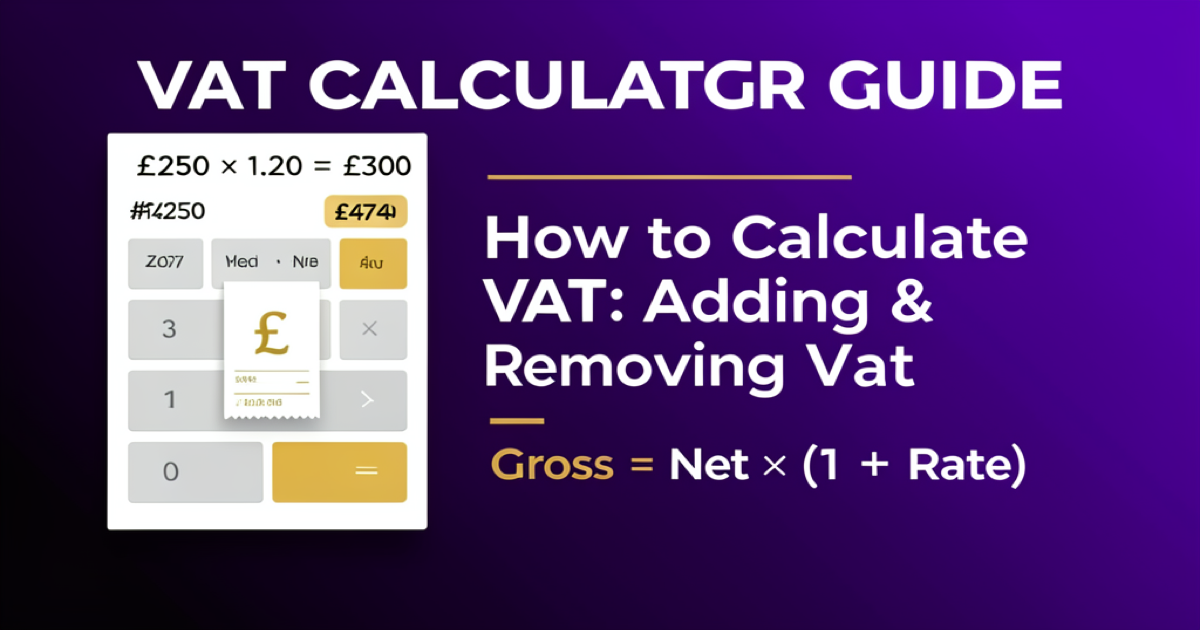
To add VAT, multiply the net price by 1 plus the VAT rate; to remove VAT, divide the gross price by 1 plus the VAT rate.At the UK’s standard 20% rate, that means multiplying by 1.20 to add VAT and dividing by 1.20 to strip it back out. So a £250 net price becomes £300 with VAT, and a £300 gross price reverses to £250 net — with £50 of VAT either way.
It sounds simple, but there’s one mistake almost everyone makes when removingVAT — and it quietly overstates the tax every time. This guide shows the correct formulas, walks through worked examples, and lists the standard rates for the UK, EU, UAE and beyond so you can work out VAT for any country with confidence.
Skip the maths — add or remove VAT instantly for 40+ countries.
Open the free VAT Calculator →Key Takeaways
- Add VAT: net price × (1 + rate). At 20%, multiply by 1.20.
- Remove VAT: gross price ÷ (1 + rate). At 20%, divide by 1.20 — never subtract 20%.
- VAT is always charged on the net price, which is why reversing it needs division, not subtraction.
- Only the rate changes between countries — the method is identical everywhere.
🎙 Listen to the full podcast episode
🎬 Watch: VAT explained in 5 minutes
Advertisement Space
What Is VAT?
VAT — Value Added Tax — is a consumption tax added to the price of most goods and services. It’s collected in stages along the supply chain, but ultimately it’s the final customer who pays it. Businesses act as collectors: they charge VAT on what they sell (output VAT) and reclaim the VAT on what they buy (input VAT), handing the difference to the tax authority.
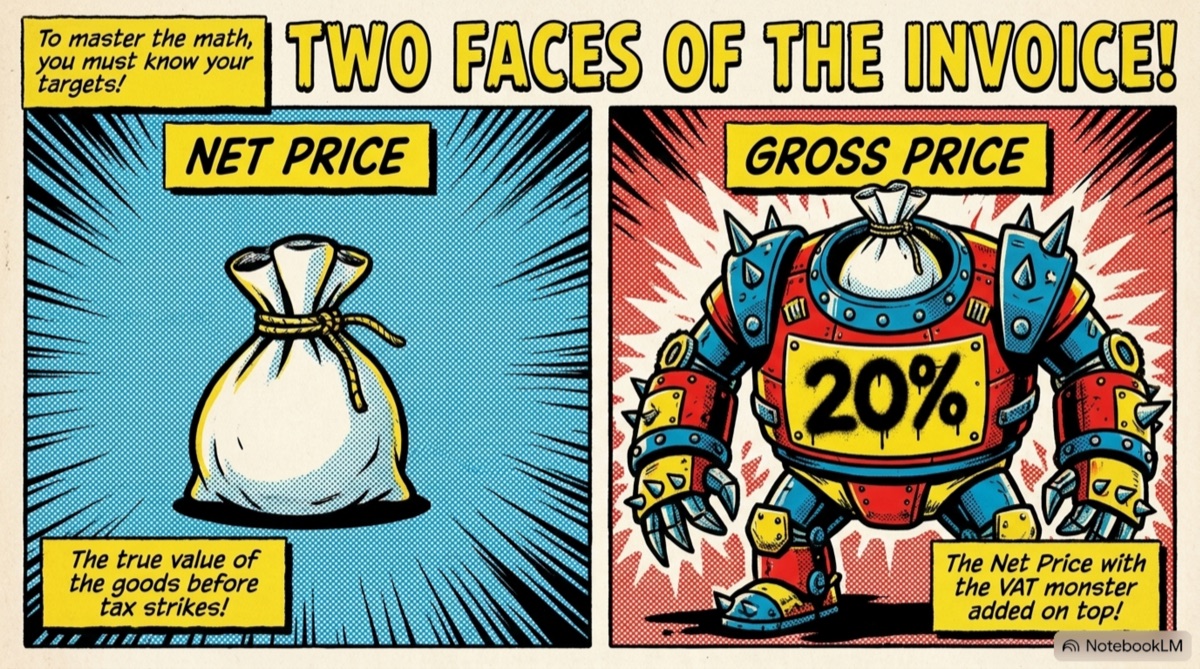
Two figures matter for every calculation. The net price is the value of the goods before tax. The gross priceis the net price with VAT added on top. VAT is always a percentage of the net price — that single fact is the key to calculating it correctly in both directions.
How to Add VAT to a Price
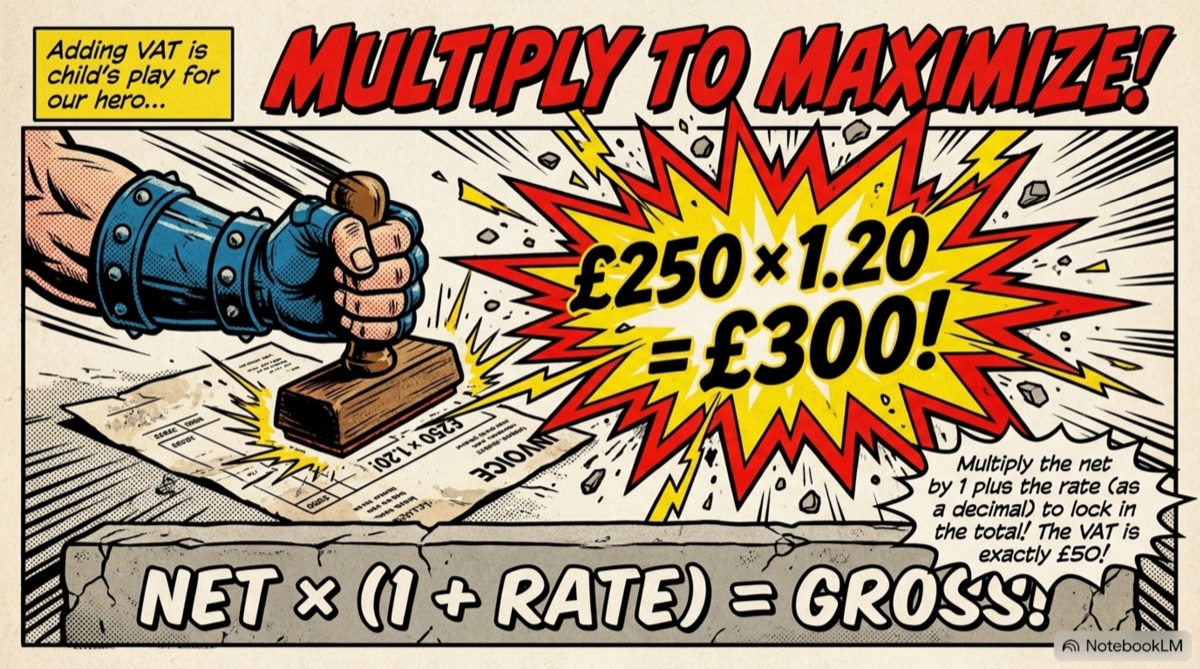
Adding VAT is the easy direction. Multiply the net price by 1 plus the VAT rate expressed as a decimal:
Gross = Net × (1 + Rate)
Say you’re a freelancer invoicing £250 of work and you need to add 20% VAT:
Net = £250
VAT = £250 × 0.20 = £50
Gross = £250 × 1.20 = £300
The customer pays £300, of which £50 is VAT you’ll pass on to the tax authority. To find just the VAT amount without the total, multiply the net price by the rate on its own (£250 × 0.20 = £50).
How to Remove VAT From a Price (The Right Way)
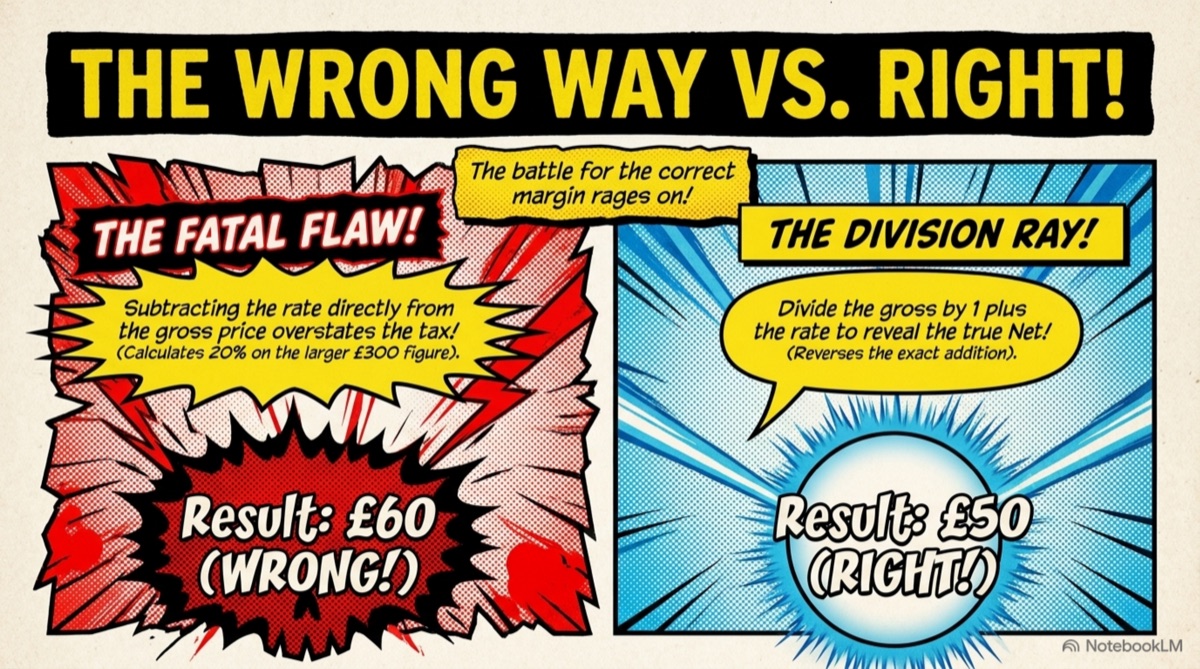
This is where people slip up. To remove VAT from a gross, VAT-inclusive price, you divideby 1 plus the rate — you do not subtract the rate:
Net = Gross ÷ (1 + Rate)
Take a £300 gross price and strip out the 20% VAT:
Gross = £300
Net = £300 ÷ 1.20 = £250
VAT = £300 − £250 = £50
The mistake to avoid
Subtracting 20% of the gross price gives £300 × 0.20 = £60 — but the real VAT is only £50. The 20% was added to the £250 net price, not the £300 gross price, so taking 20% off the larger number always overstates the VAT. Divide by 1.20 instead.
Quick shortcut for 20% VAT: to get the VAT portion of a gross total, just divide by 6 (£300 ÷ 6 = £50). That works because VAT is one-sixth of a 20%-inclusive total.
VAT Rates by Country (2026)
The formulas above work anywhere — you only swap in the local rate. Some countries call it GST (Goods and Services Tax), but the maths is identical. Here are the standard rates for common jurisdictions:
| Country | Standard rate | Notes |
|---|---|---|
| United Kingdom | 20% | Reduced 5%, zero-rated 0% |
| Ireland | 23% | Reduced 13.5% & 9% |
| France | 20% | Reduced 10%, 5.5%, 2.1% |
| Germany | 19% | Reduced 7% |
| Spain | 21% | Reduced 10% & 4% |
| Italy | 22% | Reduced 10%, 5%, 4% |
| Netherlands | 21% | Reduced 9% |
| UAE | 5% | Standard rate |
| Australia (GST) | 10% | Called GST |
| Canada (GST) | 5% | Plus provincial PST/HST |
Rates change from time to time and many countries apply reduced rates to essentials like food, energy and children’s items. Always confirm the current rate for your specific goods, then apply the same add/remove method. The free VAT calculatorkeeps 40+ countries’ rates on hand so you don’t have to look them up.

Worked Example: A Freelancer’s Invoice
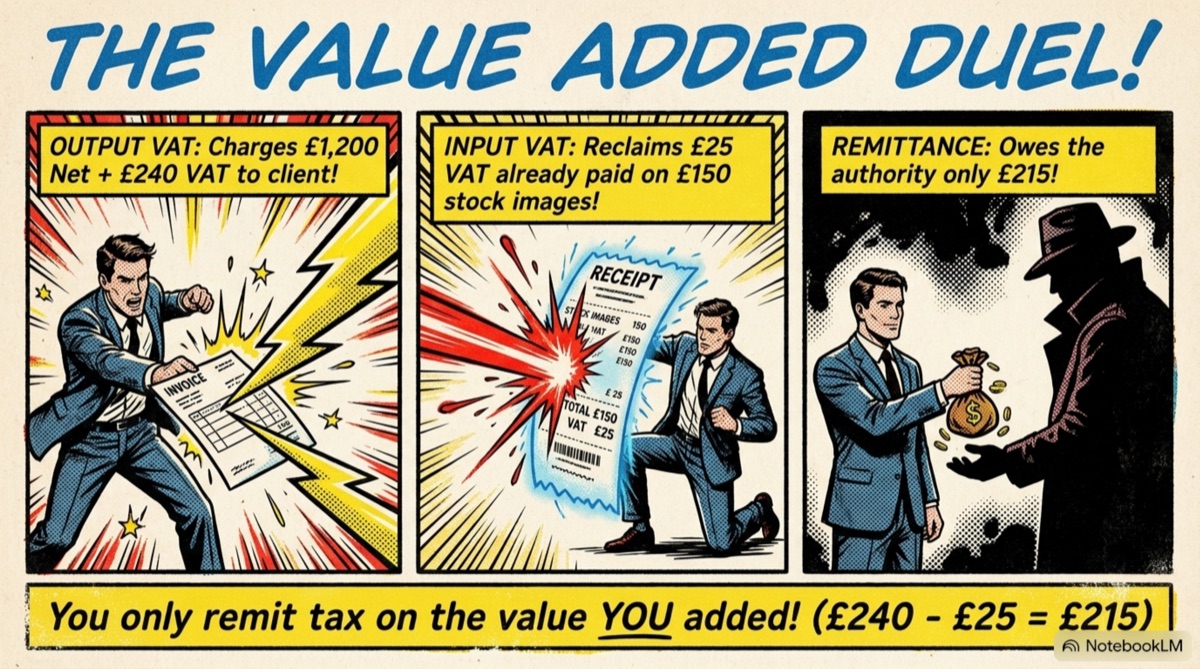
Imagine you’re a VAT-registered designer billing a client £1,200 for a project, plus £150 of stock images you bought (which already included £25 of VAT you paid). Here’s how it flows:
- Output VAT you charge: £1,200 × 0.20 = £240. Your invoice total is £1,440.
- Input VAT you paid: £25 on the stock images, which you can reclaim.
- VAT you owe the tax authority: £240 − £25 = £215.
You collected £240 from the client but only hand over £215, because you offset the £25 you already paid. That’s the “value added” idea in action — you only remit tax on the value you added, not the full sale price.
When You Might Need to Reverse VAT
Removing VAT from a gross figure comes up more often than you’d think:
Recording expenses
A receipt usually shows the gross total. To claim the VAT back, you need to split it into net and VAT — divide by 1.20 (or the relevant rate) to find the net, then subtract to get the reclaimable VAT.
Pricing a product
If you want a shelf price of exactly £9.99 including VAT, you reverse it to find your net revenue: £9.99 ÷ 1.20 = £8.33. That’s what you actually keep before other costs.
Checking an invoice
When a supplier only quotes a VAT-inclusive total, reversing the VAT lets you confirm the net cost and that the tax was applied at the correct rate.
Add or Remove VAT in One Click
Once you understand the formulas, you rarely want to do them by hand. Our free VAT calculatoradds or removes VAT for 40+ countries at standard and reduced rates, with an invoice calculator built in — no signup, no email required.
Try It Free →Running a business and want to grow it? Build your customer list with AWeber for email marketing, and generate high-converting ad copy in seconds with AdvertsGPT.
Frequently Asked Questions
How do I calculate VAT on a price?
To add VAT to a net (VAT-exclusive) price, multiply the price by 1 plus the VAT rate as a decimal. At 20% VAT, multiply by 1.20. So £250 net becomes £250 × 1.20 = £300 gross, and the VAT itself is £50. To find just the VAT amount, multiply the net price by the rate: £250 × 0.20 = £50.
How do I remove VAT from a gross price?
Divide the gross (VAT-inclusive) price by 1 plus the VAT rate. At 20%, divide by 1.20. So a £300 gross price becomes £300 ÷ 1.20 = £250 net, and the VAT is £300 − £250 = £50. Do NOT simply subtract 20% of the gross price — that gives the wrong answer (£60 instead of £50).
What is the most common VAT calculation mistake?
Removing VAT by subtracting the rate directly from the gross price. Taking 20% off a £300 gross price gives £60, but the actual VAT is £50. That's because the 20% was added to the smaller net figure (£250), not the larger gross figure. Always divide the gross price by 1.20 to reverse VAT correctly.
What is the standard VAT rate in the UK?
The UK standard VAT rate is 20%. There is also a reduced rate of 5% (on things like domestic energy and children's car seats) and a zero rate of 0% (on most food, books, and children's clothing). Businesses must register for VAT once their taxable turnover exceeds £90,000 in a 12-month period (2024/25 threshold).
How do I work out the VAT amount from a total?
If you have a VAT-inclusive total and want just the VAT portion at 20%, divide the total by 6. A £300 gross total ÷ 6 = £50 of VAT. This shortcut works because VAT is 20% of the net price, which is 1/6 of the 120% gross total. For other rates, use gross − (gross ÷ (1 + rate)).
Is VAT calculated on the net or gross price?
VAT is always calculated on the net (VAT-exclusive) price — the value of the goods or service before tax. The gross price is the net price plus VAT. This is why removing VAT requires division rather than subtraction: you're working backwards from the gross figure to recover the net price the VAT was based on.
Do different countries use different VAT rates?
Yes. VAT rates vary widely: the UK and France are 20%, Germany 19%, Ireland 23%, Italy 22%, Spain 21%, the Netherlands 21%, and the UAE 5%. Some countries call it GST instead of VAT — Australia's GST is 10% and Canada's federal GST is 5%. The calculation method is identical; only the rate changes.
Can businesses reclaim the VAT they pay?
VAT-registered businesses can usually reclaim the VAT they pay on business purchases (input VAT) by offsetting it against the VAT they charge customers (output VAT). They pay the difference to the tax authority. This is why VAT is described as a tax on the 'value added' at each stage rather than a tax on the business itself.
How do I calculate VAT at a reduced rate like 5%?
The method is the same — just change the multiplier. To add 5% VAT, multiply the net price by 1.05. To remove 5% VAT from a gross price, divide by 1.05. For example, £100 net at 5% is £105 gross, and £105 gross reversed is £105 ÷ 1.05 = £100 net with £5 of VAT.
Is there a free VAT calculator I can use?
Yes — ToolStack's free VAT Calculator adds or removes VAT instantly for 40+ countries at standard and reduced rates, with an invoice calculator built in. It runs entirely in your browser, needs no signup, and shows the net price, VAT amount, and gross total side by side.
Some links on this page are affiliate links. If you purchase through these links, I may earn a commission at no extra cost to you. I only recommend products I genuinely use and trust.