
TL;DR
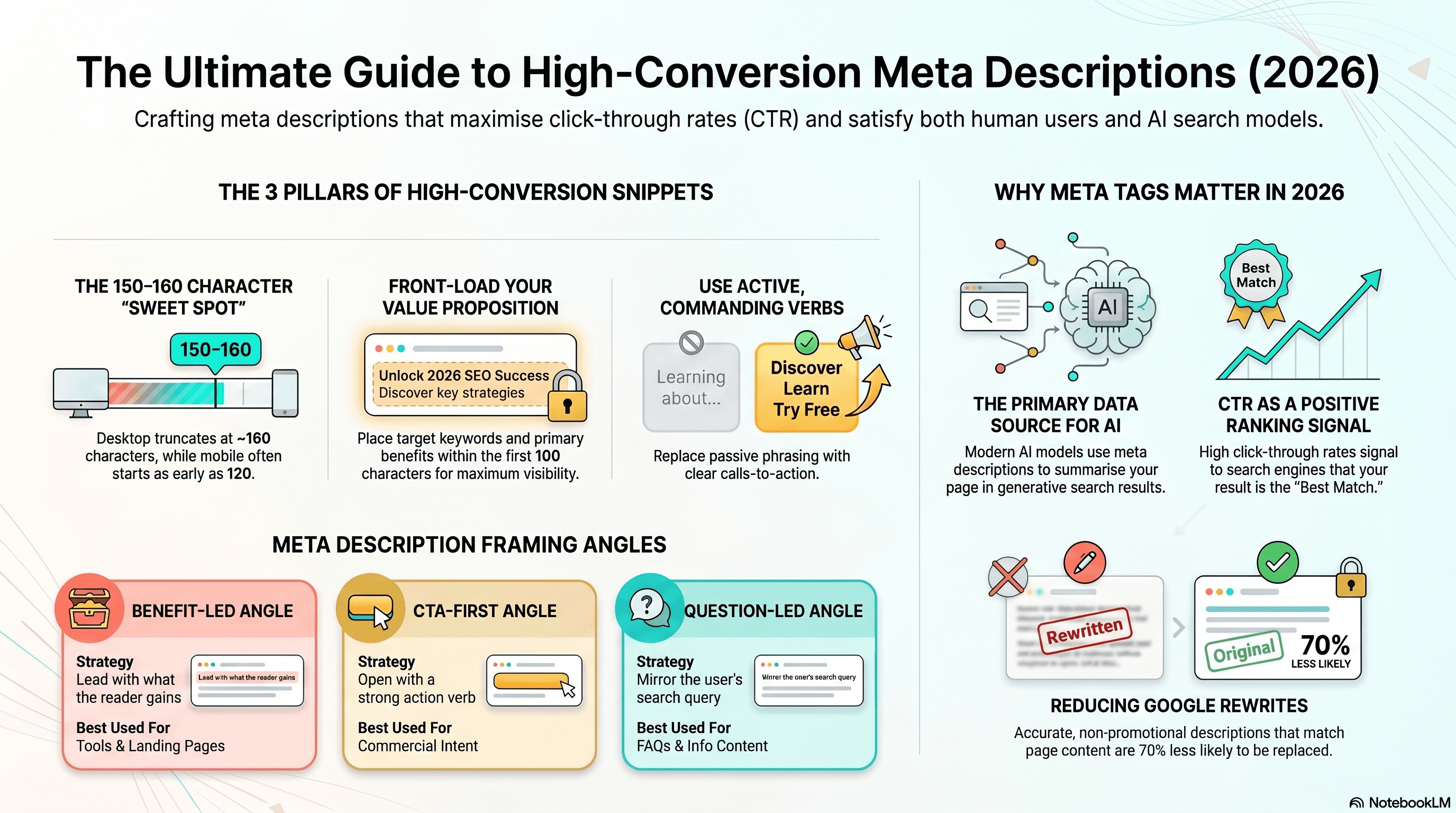
- → Google rewrites 70% of meta descriptions — accurate, non-promotional ones survive.
- → The sweet spot is 150–160 characters with your keyword in the first 100.
- → AI engines (ChatGPT, Gemini, Perplexity) now read your meta description to summarise your page.
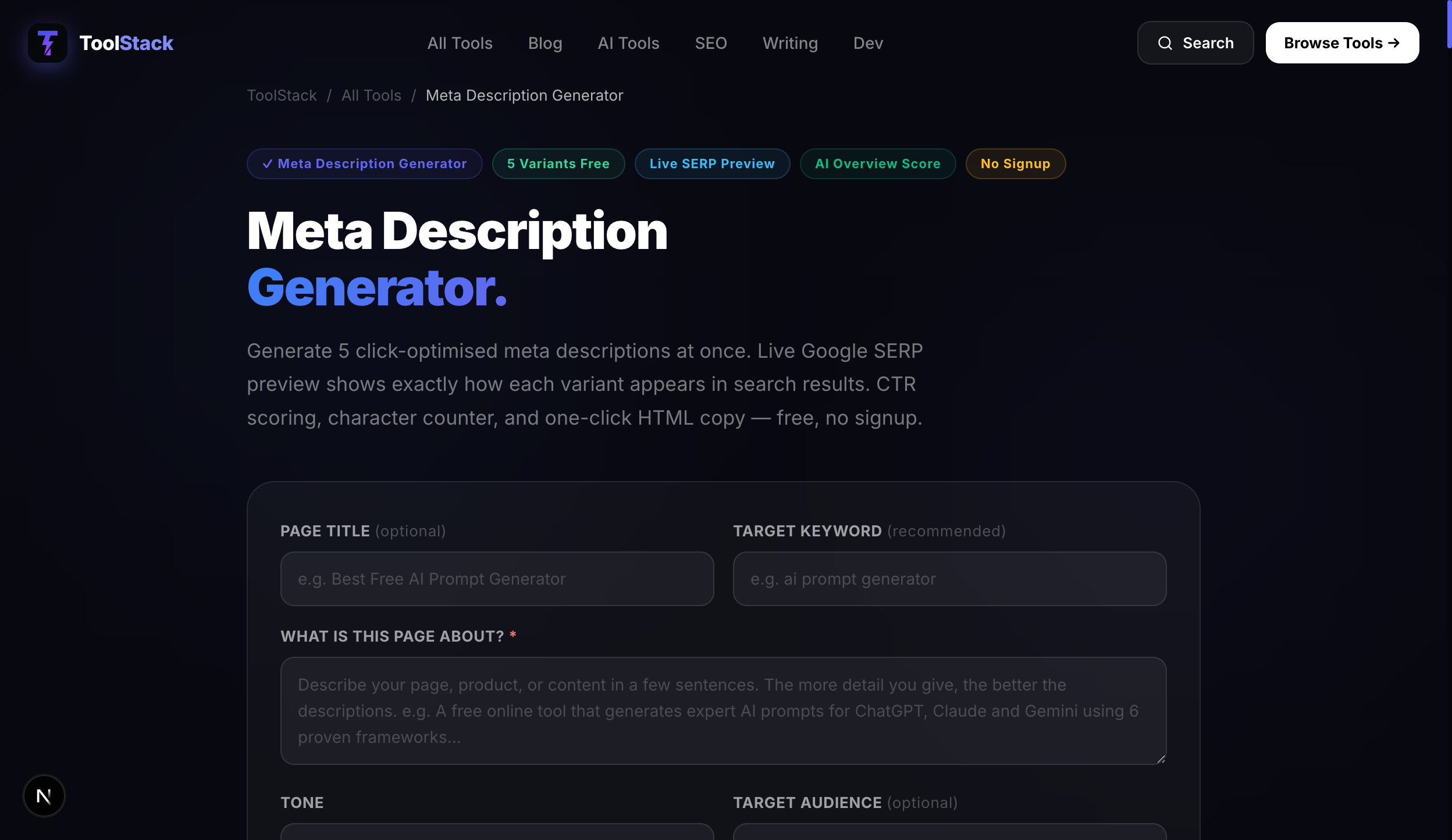
- → ToolStack's free generator produces multiple optimised variants instantly — no login needed.
Advertisement Space
Google rewrites approximately 70% of the meta descriptions it encounters. That means most of the snippets you carefully write get replaced with whatever Google pulls from your page. The fix isn't clever writing tricks — it's understanding the three rules Google applies, and using a tool that enforces them automatically.
Why Google Keeps Rewriting Yours
Google rewrites meta descriptions for one reason: it thinks it can do a better job matching the user's search intent. That happens when your description is too promotional, doesn't reflect the actual page content, is too long or too short, or opens with your brand name instead of the user's keyword.
The good news: accurate, non-promotional descriptions that genuinely summarise the page are 70% less likely to be replaced. Write for the searcher, not for yourself.
In 2026 this matters more than ever. ChatGPT, Gemini, and Perplexity now read your meta description as a primary signal when summarising your page in generative AI search results. A weak meta description doesn't just hurt your Google CTR — it shapes how AI describes your brand to every user asking about your topic.
The 3 Rules of a Description Google Keeps
150–160 characters — the sweet spot
Desktop truncates at approximately 160 characters. Mobile starts cutting at 120. Write to 150–160 and front-load everything important in the first 100 characters. The ToolStack generator enforces this automatically and shows you a live character count.
Front-load your keyword and value
Place your target keyword and primary benefit within the first 100 characters. Never open with your brand name — the user already sees your page title. The meta description needs to answer: why should I click this result over the others?
Use active, commanding verbs
Discover. Try. Get. Generate. These words prompt action. Passive phrasing like 'this page covers...' signals low intent and gets rewritten every time. Treat the description like a CTA, not a table of contents.
3 Framing Angles — Pick the Right One for Your Page
Every page has a different reader intent. Match the angle to the content type:
Benefit-Led
Best for: Tool pages, landing pages, product pages
"Generate 5 SEO-ready meta descriptions in seconds. Free, no login, runs in your browser. Copy and paste directly into your CMS."
CTA-First
Best for: Commercial intent pages, comparison pages
"Discover the exact formula Google won't rewrite. Our free meta description generator hits the 150–160 character sweet spot every time."
Question-Led
Best for: FAQ pages, informational content, how-to guides
"What makes a meta description Google won't rewrite? Length, accuracy, and active verbs. Here's the complete 2026 guide."
How the Free Generator Works
The ToolStack Meta Description Generator is three steps:
- 01Paste your page title or topic into the generator
- 02The tool outputs multiple variants covering benefit-led, CTA-first, and question-led angles
- 03Pick the best one, copy it, paste it into your CMS
No login. No AI credits. No monthly plan. It runs entirely in your browser — your content never leaves your device.
Advertisement Space
Free vs Paid: How It Compares to Ahrefs
The Ahrefs meta description generator is the most-searched alternative. It's a solid tool — but it lives inside a platform starting at $129/month. If you need a full SEO suite, Ahrefs makes sense. If you just need meta descriptions, paying $129/month for a snippet generator is overkill.
Pair It With Email to Own Your Traffic
SEO drives discovery. Email owns the relationship. Once someone clicks through from search, the smartest move is to capture them on a list so you can bring them back without depending on the algorithm.
We use AWeber to manage email at ToolStack and AdvertiseGPT. It's free to start, integrates cleanly with any CMS, and gives you a direct channel to your audience that Google algorithm updates can't touch.
Generate your meta descriptions in seconds
Free. No login. No credits. Multiple optimised variants every time.
Try the Generator Free →Frequently Asked Questions
What is a free meta description generator?
A free meta description generator is a tool that automatically produces SEO-optimised search snippets for your web pages at no cost. You paste your page topic or title, and it outputs multiple ready-to-use descriptions that hit the 150–160 character sweet spot, front-load your keyword, and use active verbs that drive clicks — all without a login or subscription.
Why does Google keep rewriting my meta descriptions?
Google rewrites meta descriptions when they don't accurately match the user's search intent, when they're too long or too short, or when they're too promotional. Accurate, non-promotional descriptions that genuinely summarise the page content are 70% less likely to be replaced. A good generator applies these rules automatically.
How is this different from the Ahrefs meta description generator?
The Ahrefs meta description generator is locked inside a paid platform starting at $129/month. The ToolStack generator is completely free, requires no account, runs in your browser, and produces multiple framing variants per query — not just one. For anyone who doesn't need a full SEO suite, ToolStack is the faster, zero-cost alternative.
What is the ideal meta description length in 2026?
The sweet spot is 150–160 characters. Desktop truncates at roughly 160, mobile starts cutting at 120. Front-load your keyword and main benefit within the first 100 characters so it always displays regardless of device. The ToolStack generator enforces this automatically.
Do meta descriptions affect SEO rankings?
Not directly — but they drive click-through rate (CTR), which is a positive ranking signal. Pages with higher CTR signal to Google they're the best match for a query. Better meta descriptions → more clicks → better rankings over time. It's one of the fastest levers you can pull.
Can AI engines read my meta description?
Yes. In 2026, ChatGPT, Gemini, and Perplexity use your meta description as a primary signal when summarising your page in generative search results. A weak or missing meta description means AI misrepresents your content — or skips it entirely.